


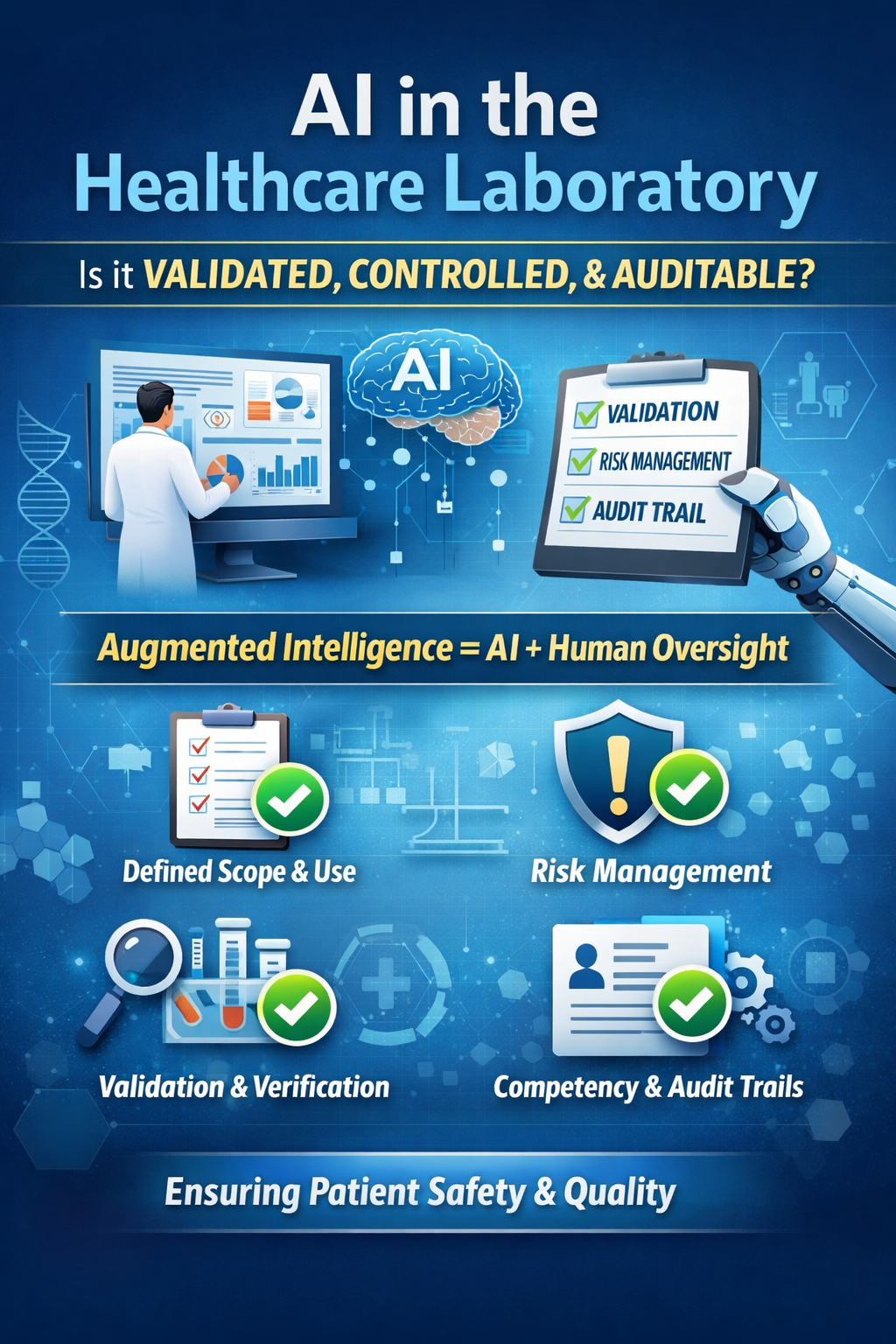
Artificial Intelligence (AI) is rapidly entering the healthcare laboratory through digital imaging, middleware decision support, instrument analytics, and operational forecasting. Yet, in an accredited laboratory environment, the central question is not “Can AI do this?” but “Can we implement it in a controlled, validated, risk-based, and auditable manner that protects patient safety?”
This is where Augmented Intelligence (AuI) becomes the practical framing for laboratories. AuI positions AI as decision support that strengthens professional judgment, rather than replacing it. For accreditation programs like ISO 15189 and CAP programs, this approach aligns naturally with core expectations: defined responsibilities, validation/verification, change control, competence, records, and continual improvement.
1) AI vs Augmented Intelligence: why the distinction matters
Artificial Intelligence (AI)
AI models learn from data and generate outputs such as classifications, predictions, or alerts. In laboratories, AI may:
- classify cells or tissues from images,
- flag atypical results/patterns,
- recommend review actions or reflex testing,
- predict analyzer downtime or QC shifts,
- optimize logistics and staffing.
Augmented Intelligence (AuI)
AuI means the laboratory implements AI in a way that:
- keeps the authorized laboratory professional responsible for the final decision,
- ensures traceability of decisions (who reviewed, what was changed, why),
- supports explainability and evidence,
- embeds AI into the QMS as a controlled process.
AuI is often the safer and more defensible pathway because it fits inspection/audits expectations around human oversight, accountability, and documented control.
2) Where AI/AuI fits in the laboratory workflow (and how to keep it compliant)
A) Pre-examination (pre-analytical): preventing errors before they reach testing
Because many laboratory nonconformities originate pre-analytically, AI can be valuable for:
- predicting hemolysis or transport-related risks,
- identifying recollection patterns by unit/collector/time,
- optimizing transport routes and pickup windows,
- detecting unusual specimen rejection trends.
This supports risk-based thinking and quality indicators. But the lab must define the AI output as a controlled input into the process (e.g., “risk flag prompts review” not “automatic rejection”).
B) Examination (analytical): QC intelligence, instrument performance, and drift detection
AI can enhance analytical assurance by:
- detecting subtle QC shifts earlier than rule-based systems,
- correlating environmental conditions with analyzer instability,
- predicting maintenance needs using error code and service history trends.
Treat these as extensions of equipment monitoring and QC processes—requiring documented acceptance criteria, response actions, and records.
C) Post-examination: result triage and augmented autoverification
Labs already use rules-based autoverification. AI can augment this by learning typical patterns across:
- delta checks and historical results,
- analyzer flags and QC status,
- multi-analyte correlations (within validated scope).
A strong approach is human-in-the-loop autoverification:
- AI recommends a review path (e.g., “low-risk; suitable for autoverification”),
- the lab defines when human authorization is mandatory (critical values, defined flags, high-risk assays),
- all AI-influenced releases remain traceable, reviewable, and override-capable.
3) ISO 15189/CAP control framework for AI in the QMS
To implement AI/AuI in an inspection-ready way, treat it as a system affecting examination and/or reporting and place it under full QMS control.
3.1 Intended use and scope definition
Define clearly:
- what the AI does (decision support, triage, classification, prediction),
- where it sits (pre-analytical, analytical, post-analytical),
- limitations and exclusions (populations, specimen types, analytes),
- the required user role (who can act on the AI output).
This “intended use” statement becomes the anchor for validation, competency, and audit.
3.2 Risk management (before go-live and ongoing)
A risk-based approach should include:
- hazard identification (wrong classification, missed abnormality, false reassurance, alert fatigue),
- failure modes and controls (review rules, hard stops, escalation pathways),
- severity/likelihood assessment and risk acceptability,
- residual risk evaluation after controls,
- monitoring plan and triggers for review.
AI errors can be systematic, not random; so detection and mitigation must be proactive.
3.3 Validation/verification: proving fitness for purpose
The lab must establish documented evidence that AI performs acceptably in its intended use environment.
A defensible validation file typically includes:
- performance metrics relevant to clinical risk (sensitivity/specificity, PPV/NPV, false negative rate, agreement statistics, trend detection performance),
- representative local data (or justified bridging studies),
- comparison to an established reference method or expert consensus where applicable,
- defined acceptance criteria (pre-approved),
- testing across edge cases (rare patterns, outliers, interferences),
- verification after installation/integration (interfaces, LIS/middleware behavior),
- documented approval before use.
Important: If the AI output influences release/reporting, validation must cover the full workflow, not only model accuracy.
3.4 Change control and revalidation (AI drift is real)
AI systems can change due to:
- vendor model updates,
- analyzer method changes,
- reagent/lot changes,
- shifts in patient population,
- workflow changes (collection sites, transport, staffing).
ISO/CAP-aligned practice requires:
- formal change control for model/version updates,
- impact assessment and decision on partial vs full revalidation,
- controlled deployment (staging → production),
- post-change monitoring,
- documented approvals and communication to users.
A simple rule that inspectors appreciate: “No silent changes.”
3.5 Competency and training: treating AI use as a defined skill
AI introduces new competencies:
- interpreting AI outputs and confidence/flags,
- understanding limitations and when to override,
- applying SOP-defined escalation pathways,
- documenting decisions appropriately.
To stay compliant, the lab should:
- define training requirements before access is granted,
- assess competency initially and periodically,
- include AI-related scenarios in competency (case-based review is effective),
- document retraining after major model updates or process changes.
3.6 Audit trails, records, and traceability (non-negotiable)
Accredited labs must be able to reconstruct decisions. For AI-supported processes, the record should allow an auditor to answer:
- What AI version/model was used?
- What did it output (flag, score, recommendation)?
- Who reviewed it and when?
- What action was taken (released, held, repeated, referred)?
- If overridden, what was the rationale?
- Was QC acceptable at the time?
- Were there related incidents, complaints, or nonconformities?
This requires:
- system audit logs,
- controlled access,
- retention aligned with record retention policy,
- periodic audit of overrides, false alerts, and adverse events.
4) CAP/ISO inspection readiness: what auditors typically look for
Even when checklists don’t mention “AI” explicitly, the expectations map cleanly to common accreditation themes. Inspectors generally want to see:
- documented intended use and controlled SOPs
- validation/verification evidence with acceptance criteria
- risk assessment and mitigation controls
- change control with version traceability
- competency records for users
- quality indicators and ongoing monitoring
- event management (nonconformities, incident reporting, CAPA)
- audit trail and record retention
- vendor qualification and service/support agreements (as applicable)
If you can demonstrate these elements, AI becomes “just another controlled process” in the QMS exactly the posture that withstands inspection.
5) Practical implementation model: “Augmented, not autonomous”
A lab-safe and inspection-ready model is:
- AI suggests / flags (never silently changes results).
- Human reviews per SOP decision rules.
- Human authorizes release where required.
- System records AI output + user action + justification.
- Quality monitors performance, overrides, drift, incidents.
- Changes controlled with revalidation as appropriate.
This approach preserves patient safety, professional accountability, and auditability.
Conclusion: Building the augmented laboratory under the QMS
AI will increasingly shape laboratory practice, but the laboratories that succeed will not be those that “adopt AI fastest.” They will be those that adopt it most responsibly with validated performance, defined clinical boundaries, trained staff, documented oversight, and complete traceability.
So, the message is simple: AI is acceptable when it is controlled, validated, risk-managed, competency-supported, and auditable—like any other process that affects patient results.
Disclosure: This post reflects my personal views and professional reflections. It should not be considered a compliance-ready confirmation or formal accreditation guidance. Implementation approaches may vary by laboratory scope, risk profile, and applicable regulatory/accreditation requirements.